
Introduction
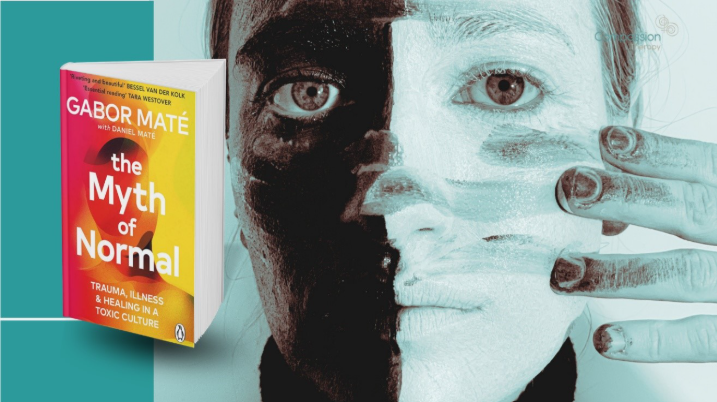
Many clients arrive at their first Compassionate Inquiry™ session carrying heavy labels: depression, anxiety, autoimmune disease, addiction. They believe these diagnoses mean something is inherently wrong with their genetics or their character, and they sit down already convinced they are the problem. The Myth of Normal dismantles this assumption by zooming out from the individual to examine the society as a whole. Gabor Maté argues that chronic physical and mental illnesses are not random anomalies; they are the expected, natural responses to an inherently unnatural and toxic culture. For a CI client, that shift in perspective is genuinely revolutionary. It stops them from pathologising themselves. When a client understands that their relentless anxiety or their drive to compulsively
caretake for others are predictable adaptations to a culture that routinely undermines core human needs, they can finally move from self-blame to self-compassion.
Summary of the Book
The Myth of Normal posits that our modern, hyper-individualistic society has normalised conditions that are actually devastating to human health. We have built a world that prizes profit, endless doing, and emotional suppression over our biological requirements for connection, rest, and authenticity. Maté explains how the stress of living in this culture gets “under the skin” via the nervous and immune systems, driving the epidemics of chronic illness, burnout, and addiction we see today. The book masterfully blends cutting-edge neuroscience and epigenetics with deep sociological critique, demanding that we rethink illness not as a static “thing” to be warred against, but as a dynamic process and a meaningful response to our environment.
The Clash Between Attachment and Authenticity
One of the most foundational principles in CI is the inherent conflict between attachment (our drive to connect and belong) and authenticity (our drive to be true to ourselves). Children absolutely require attachment to survive; therefore, if expressing their true feelings threatens their connection to their parents, they will suppress their authenticity. Society further rewards this suppression, praising children for being “good” and adults for being compliant. Maté shows how this constant self-betrayal literally damages our biology, leading to autoimmune conditions and depression.
The Myth of the “Happy Childhood”
A common hurdle in CI sessions is the client who insists, “But I had a perfectly happy childhood!” Maté dismantles this illusion by expanding our definition of trauma. Trauma isn’t only about horrible things happening to you (like abuse); it also happens when essential things fail to happen (like emotional attunement). A child can grow up in a materially comfortable home with well-meaning parents, yet still suffer developmental trauma because they were not allowed to express anger, sadness, or vulnerability. Recognising this allows clients to validate their pain without having to paint their parents as villains.
Illness as a Teacher
Rather than viewing disease purely as an enemy to be eradicated, Maté explores how illness can function as a desperate message from the body. When the authentic self has been silenced for too long, the body eventually says “no” in the form of physical breakdown. CI practitioners draw on this concept by helping clients initiate a conversation with their symptoms. When clients ask their illness or depression what it is trying to protect them from, they often discover profound lessons about boundary-setting and the necessity of reclaiming their true identity.
Conclusion
There is a quiet liberation in reading this book alongside CI work. The Myth of Normal provides the sociological and scientific scaffolding that frees clients from the isolated prison of their diagnosis.
By revealing that our suffering is a normal reaction to an abnormal world, it invites clients to wake up from the toxic trance of modern society, to stop adapting to systems that destroy them, and to undertake the courageous journey back to wholeness.